Backflow Testing & Repair in Newport Beach, CA — Tested, Repaired, and Filed With the City
In Newport Beach, backflow testing is not optional and it is not a sales pitch — it is city law. Under Newport Beach Municipal Code Title 14, Chapter 14.10 (§14.10.025), every backflow prevention assembly must be tested annually, and again after any installation, repair, or relocation, by a certified tester, with the report filed with the city. The city mails a reminder about 30 days before your due date, and failing to test can lead to water shutoff under §14.10.035. We do the whole job in one visit: certified test, repair if the assembly fails, and the city filing — with a copy in your inbox the same day, so the letter you got from the city is answered, not just handled.
What Backflow Is — and Why Newport Beach Takes It So Seriously
Backflow is water flowing the wrong way through your plumbing: instead of clean city water flowing into your home, contaminated water flows back into the public supply. It happens in two ways. Backsiphonage occurs when a main break or a fire hydrant in use drops pressure in the street main, creating a vacuum that pulls water backward out of your property. Backpressure occurs when something on your side — a boiler, a pump, a dockside hose sitting in harbor water — pushes water back at higher pressure than the city main. Either way, the water that returns can carry fertilizer from an irrigation system, chemicals from a pool or spa, bacteria from a dock hose, or boiler treatment chemicals. A backflow prevention assembly sits between your property and the city main and stops that reverse flow. It is a small brass device with an outsized job, and it is the reason Newport Beach — a city of waterfront homes, irrigation-heavy landscaping, pools, and hundreds of docks — regulates it assembly by assembly.
Newport's geography makes this more than a paperwork exercise. Every pier and dock in the city requires a reduced-pressure (RP) assembly — installed downstream of the meter, landward of the bulkhead, with 12 inches of clearance, from the USC Foundation's approved list — because a dock hose that drops into harbor water is a direct cross-connection to the drinking supply. Irrigation systems, pools and spas, fire sprinkler systems, and commercial properties each carry their own hazard level and their own required device type. The city's cross-connection program exists because one failed assembly at one property can affect the whole street. That is also why the test is annual and the filing is mandatory: an assembly that worked last year may not work this year, and the city has no way to know unless someone certified tests it and files the report.
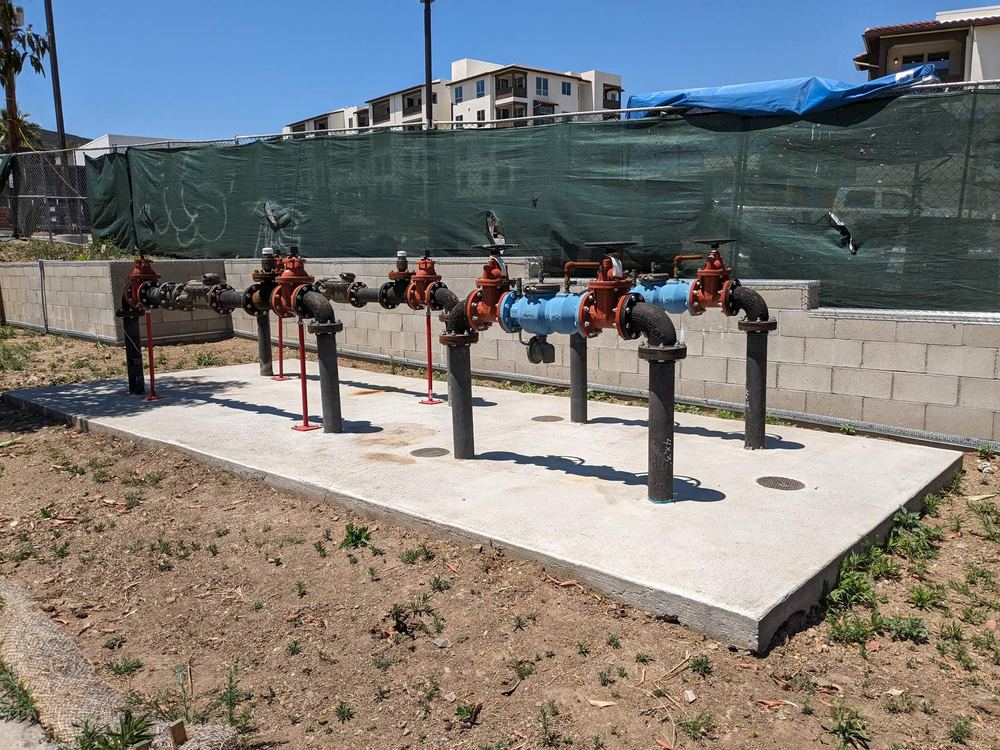
Which Device Do You Have? The Four Types We Test
The device on your property is determined by the hazard it protects against. Most Newport Beach homeowners will recognize one of these four, and the test procedure — and the failure modes — differ for each:
Reduced-Pressure (RP) Assembly
The highest level of protection, required for high-hazard connections — every dock and pier, and any property where chemicals or harbor water could enter the supply. Two check valves with a relief valve between them. The relief valve is the tell: if it drips or discharges constantly, the assembly needs attention, not a bucket underneath it.
Double Check Valve (DC) Assembly
Two check valves in series, used for lower-hazard connections such as many irrigation systems and commercial properties without chemical injection. No relief valve, so a failure is silent — which is exactly why the annual test matters. A DC assembly can fail and look perfectly fine from the outside.
Pressure Vacuum Breaker (PVB)
Common on residential irrigation systems. It protects against backsiphonage only, must be installed above the highest sprinkler head, and is vulnerable to freeze damage and to being buried by landscaping — both common causes of a failed test in Newport's older irrigation installations.
Atmospheric Vacuum Breaker (AVB)
The small device often found on individual hose bibbs and some irrigation zone valves. It protects one outlet against backsiphonage, cannot be under continuous pressure, and must sit above the outlet it serves. If your AVB is installed below grade or under constant pressure, it is not protecting anything.
Not sure which one you have? Send us a photo of the assembly and its tag, or just tell us the property type and the city letter's device description — we will identify it before the visit, so the tester arrives with the right rebuild kit and the right test equipment, not a guess.
What a Certified Backflow Test Actually Involves
A backflow test is not a visual inspection. A certified tester connects a calibrated differential-pressure test kit to the assembly's test cocks and measures, valve by valve, whether each check valve holds against reverse pressure and — on an RP assembly — whether the relief valve opens at the correct differential. The readings are recorded on the test report, which is what the city files. The whole test typically takes 20–40 minutes for a single assembly, longer for a dock assembly that needs access work or for a property with several assemblies. Here is what to expect:
1. Identify and access
We locate every assembly on the property, confirm it against the city's records for that address, and check its installation: clearance, drainage for the relief valve, protection from damage, and whether landscaping or construction has buried or boxed it in since last year.
2. Test each valve
Using a calibrated test kit, we measure each check valve and the relief valve against its required values. A pass is a set of numbers, not an opinion — and you get those numbers on your copy of the report.
3. Repair on the spot if it fails
Most failures are worn check valve discs, fouled seats, or a relief valve that will not hold — all rebuildable with a kit for that assembly model. We rebuild, retest, and record both results. If the assembly body is cracked or obsolete, we price a replacement rather than rebuilding a device that will fail again next year.
4. File with the city
The completed test report is filed with the City of Newport Beach, and a copy goes to you the same day. For Newport Coast and Crystal Cove (92657), the filing goes to the Irvine Ranch Water District (IRWD) instead — different agency, same discipline, and we file to the right one for your address.
One caution worth stating plainly: some older city handouts still cite the old state "Title 17" rules. California replaced those with the CCCPH cross-connection handbook in 2024, and current Newport code is Title 14, Chapter 14.10. If a company quotes you Title 17 requirements, its paperwork is out of date — and the filing it produces may be too.
Backflow Pricing — Published, Flat, In Writing
Typical Newport Beach ranges. Your exact flat-rate quote is written before work begins; the city filing is included in the test price, never added as a separate line.
| Backflow job | Typical Newport Beach range |
|---|---|
| Annual certified test, single assembly (report filed with the city) | $95–$175 |
| Dock / pier RP assembly test (access work included) | $125–$225 |
| Retest after repair or installation | $75–$125 |
| Rebuild — check valve kit, per assembly (parts + labor + retest) | $250–$600 |
| RP assembly replacement (device + installation + test + filing) | $800–$1,800 |
| Double check assembly replacement | $600–$1,200 |
| Annual program — HOA / property management, per assembly | quoted per property count |
Ranges are typical-market figures for planning. The variable that moves a replacement price is size and access: a 3/4-inch assembly in an open planter is one job, a 2-inch dock RP assembly behind a bulkhead gate is another, and a written quote should say which one it is pricing. If a previous company "handled" your test but the city is still writing to you, the filing never happened — ask any new tester to confirm the filing in writing, and keep your copy.
What Happens If You Miss the Test — or If the Assembly Fails
Missing the annual test is not a fine in the first instance; it is a process that ends somewhere you do not want to be. The city sends a reminder about 30 days before the due date. If no passing test report is filed, the city follows up, and under §14.10.035 non-compliance can lead to water shutoff until a passing test is on file. For a rental, a second home, or a property in escrow, that timeline is what catches people: the letter goes to the address on file, the owner is elsewhere, and the shutoff notice arrives when a tenant or a buyer discovers there is no water. If you have received a city letter and are not sure whether your test is current, call us with the address — we can check the property's assemblies and schedule the test before the deadline, not after it.
A failed test is a different, more urgent situation: until the assembly is repaired and retested, the cross-connection it protects is unprotected. Most failures are repaired the same visit with a rebuild kit. What you should not do is ignore a failed assembly because it "still works for watering the lawn" — the assembly's job is not to water the lawn, it is to protect the street's drinking water, and a failed check valve protects nothing. After any repair, installation, or relocation, the assembly must be retested and the new report filed — the retest is part of the repair, not a second job to be sold separately.
Backflow Testing Across Newport Beach
Balboa Island · 92662
Bayfront homes around the Grand Canal with dock RP assemblies — the densest dock backflow territory in the city. Annual dock RP tests, rebuilds, and city filings, scheduled around ferry and narrow-street access.
Lido Isle · 92663
Gated island homes, docks on all sides, and many second homes whose city letters sit unread. We schedule with the gate in mind and send the filed report to the owner wherever they are.
Balboa Peninsula · 92661
Dock and pier RP assemblies plus older irrigation PVBs, many installed decades ago and never relocated when landscaping changed. Installation corrections are common here.
Newport Coast & Crystal Cove · 92657
Served by IRWD, not the City of Newport Beach — different filing agency, different reminder cycle. We file to IRWD for these addresses and track the IRWD due date, not the city one.
Corona del Mar · 92625
Irrigation-heavy hillside properties with PVB and DC assemblies protecting extensive landscaping and pools. Freeze and landscaping damage are the usual failure causes.
Newport Heights & Dover Shores · 92660
Mid-century homes with older irrigation assemblies, plus HOA and multi-unit properties that need annual programs with documentation boards can actually use.
West Newport · 92663
Commercial and multi-unit properties along the Superior Avenue corridor, where DC assemblies and fire-system devices need annual programs, not one-off tests.
Backflow FAQs — Newport Beach
Do I really have to test my backflow preventer every year?
Yes. Under NBMC Title 14, Chapter 14.10 (§14.10.025), backflow assemblies must be tested annually, and again after any installation, repair, or relocation, by a certified tester, with the report filed with the city. The city mails a reminder about 30 days before your due date, and failing to test can lead to water shutoff under §14.10.035.
What does a backflow test actually check?
Using a calibrated test kit, the tester measures each check valve against its required holding values and, on an RP assembly, whether the relief valve opens at the correct differential. A pass is a set of recorded numbers on the test report — not a visual opinion — and that report is what gets filed with the city.
Is a dock or pier backflow assembly different from a regular one?
Yes. Every pier and dock in Newport Beach requires a reduced-pressure (RP) assembly — installed downstream of the meter, landward of the bulkhead, with 12 inches of clearance, from the USC Foundation's approved list — because a dock hose in harbor water is a direct cross-connection. Dock RP tests typically cost more than a standard test because of access work, and the assembly must be tested annually like any other.
What happens if my assembly fails the test?
Most failures are worn check valve discs, fouled seats, or a relief valve that will not hold, and most are rebuilt on the spot with a kit for that model, then retested. If the body is cracked or the model is obsolete, we price a replacement instead. After any repair, the assembly must be retested and the new report filed with the city.
I live in Newport Coast. Is my backflow filing different?
Yes. Newport Coast and Crystal Cove (92657) are served by the Irvine Ranch Water District (IRWD), not the City of Newport Beach, so the test report is filed with IRWD, on IRWD's cycle. Tell us your address and we file to the right agency — filing a city report for an IRWD property, or vice versa, leaves you unfiled either way.
How much does backflow testing cost in Newport Beach?
A single annual certified test typically runs $95–$175 with the city filing included, and a dock or pier RP test $125–$225. A rebuild after a failed test typically runs $250–$600 including the retest, and a full RP replacement $800–$1,800 depending on size and access. Every job is quoted in writing before work begins.
Tested. Repaired. Filed. Done.
Got a city letter, a due date, or a dock assembly that needs its annual test? One visit, one filed report, one less thing on your list. Serving every Newport Beach neighborhood.
☎ Call (949) 693-0223