Sewer Line Repair & Replacement in Newport Beach, CA — See Inside Your Pipe Before You Pay
About 61% of Newport Beach homes were built before 1980, and a great many of them still sit on their original sewer laterals — clay pipe with joints that shift, cast iron that corrodes, and root systems that have had fifty years to find every opening. A sewer lateral is the pipe that carries everything from your home to the city main, and when it fails, the symptoms show up inside your house first: backups, gurgling, slow drains that no amount of plunging fixes. Our rule is simple and non-negotiable: camera first, quote second. You see the footage, we price the fix from what the footage actually shows, and nobody sells you a full replacement for a line that needs a spot repair — or a spot repair for a line that is done.
Signs Your Sewer Lateral Is Failing
A single slow drain is usually a local clog — a job for drain cleaning. A failing lateral announces itself differently, because it affects the whole house at once. Call for a camera inspection if you notice any of these:
- Multiple fixtures backing up at once — the toilet gurgles when the washing machine drains, or the shower fills when you flush. That is a main-line problem, not a single-fixture clog.
- Recurring backups in the same place — a drain that clogs again weeks after it was cleared almost always has a structural cause: roots, a bellied section, a broken joint, or a collapsed segment.
- Sewage smell in the yard, the garage, or a low bathroom — especially after heavy water use or after a king tide. Tide-driven backups in low-lying Peninsula, Island, and West Newport streets often expose a lateral that was already cracked.
- Unusually lush, green patches or soggy spots in the yard — a leaking lateral fertilizes the lawn above it, and in Newport's sandy soil the ground above a break can settle or sink.
- Gurgling from toilets and floor drains — air trapped by a partial blockage or a belly in the line, pushed back through the nearest trap.
- Foundation or driveway cracks near the lateral's path — a long-running leak washes fines out of sandy soil, and the surface above it settles. This is not a diagnosis by itself, but combined with backups it belongs in a camera inspection.
If sewage is actively backing into the house, stop using water, keep people and pets out of the affected area, and call — raw sewage is a health hazard, not a wait-until-morning problem. That is an emergency plumber call, day or night.
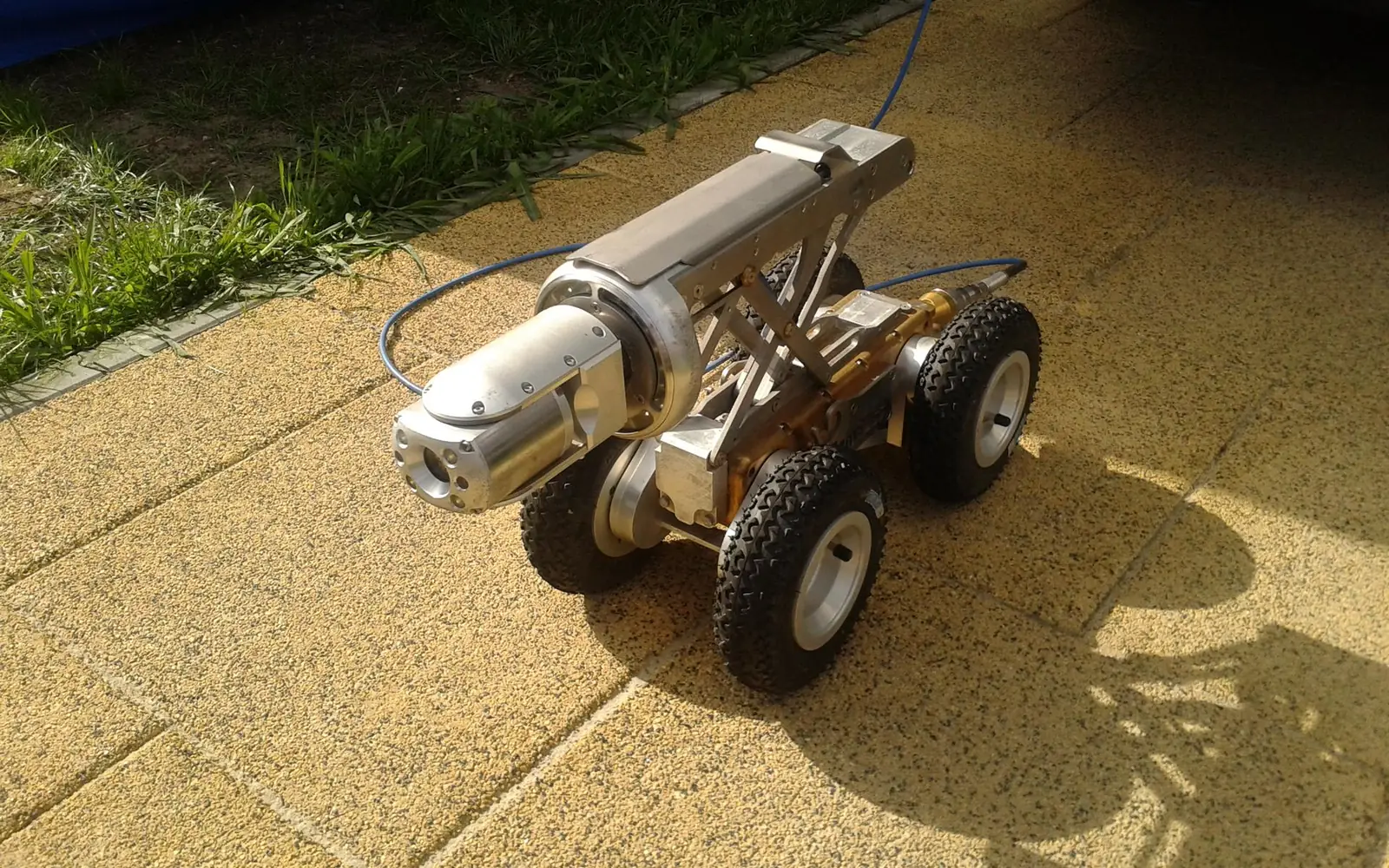
What the Camera Usually Finds in Newport Beach
Newport's laterals are old, and old laterals fail in predictable ways. Knowing which pattern yours follows is what separates an honest quote from a guess:
Root Intrusion
Clay pipe joints were never watertight, and fifty years of ficus, palm, and street-tree roots have found them. Roots start as hairline strands and grow into mats that catch everything passing through. Early root intrusion can be cut and managed; a joint packed solid with roots and displaced by growth usually cannot.
Offset Joints & Bellies
Sandy soil shifts. When a section of pipe settles lower than the sections around it, wastewater pools in the belly instead of flowing, and solids drop out and build up. Bellies cause repeat clogs in exactly the same spot — the signature symptom that points a camera crew to the right section.
Cast-Iron Corrosion & Scale
Older cast-iron laterals corrode from the inside out. The bore narrows with scale and tuberculation, flow slows, and the pipe wall thins until it cracks or collapses. A corroded cast-iron line that looks intact on the surface can be paper-thin inside — another reason the camera, not the curb, decides.
Cracks, Breaks & Collapse
Heavy loads, ground movement, and decades of corrosion eventually break pipe outright. A collapsed section blocks flow completely and shows up as a sudden, total backup — and it is the one failure mode where trenchless lining is generally off the table, because there is no intact host pipe left to line.
One Newport-specific wrinkle: in low-lying streets, high tides and storm surges push water back toward homes through laterals that are already compromised. If your backups track with king tides — the next windows after Oct 26–28, 2026 are Nov 24–26 and Dec 23–25, 2026 — say so when you call. It changes what we look for on the camera and whether a backwater valve belongs in the fix.
Spot Repair vs. Trenchless vs. Open Trench — Decided by Evidence
There is no single right way to fix a sewer line. There is a right way for your line, and it depends on the material, the damage, the depth, and what sits above it. Here is how the options actually compare:
Spot Repair
When the camera shows one bad joint or one cracked section and the rest of the line is sound, we excavate that one spot and replace it. Smallest footprint, lowest cost, and the right answer — but only when the rest of the pipe genuinely earns a pass. Selling a spot repair on a line with five failing joints just schedules the next four emergencies.
Trenchless Lining (CIPP)
A resin-saturated liner is pulled through the existing pipe and cured in place, creating a new pipe inside the old one. Minimal excavation — usually just the access points — so driveways, patios, and landscaping survive. It needs a host pipe that is still structurally continuous: cracks and root damage qualify, collapse generally does not.
Pipe Bursting
A bursting head pulls a new pipe through the old line's path, fracturing the old pipe outward as it goes. It replaces the line entirely without an open trench, and it can upsize the diameter where the old line was undersized. It needs clear access at both ends and a path free of conflicting utilities.
Open-Trench Replacement
The honest answer when the line has collapsed, when the grade is wrong and must be re-established, or when trenchless access is impossible. It costs more in restoration — driveway, hardscape, landscaping — but it lets us set the new pipe's grade exactly, and for a fully failed line it is the only method that works. We price the restoration with the pipe, not as a surprise afterward.
A warning worth repeating: any company that quotes a full sewer replacement by phone, without a camera in the line, is guessing with your money. The camera run takes under an hour in most homes, and it is the difference between a $2,000 spot repair and a $15,000 replacement sold on a hunch. If another company's quote has no footage behind it, get a second opinion before you sign.

Sewer Line Pricing — Published, Flat, In Writing
Typical Newport Beach ranges. The documented planning range for a sewer lateral replacement is $3,000–$15,000 depending on depth, length, and method — your exact flat-rate quote is written and signed before work begins, after the camera inspection.
| Sewer line job | Typical Newport Beach range |
|---|---|
| Sewer camera inspection (with recorded footage) | $195–$450 |
| Root cutting / main-line clearing | $250–$650 |
| Spot repair (single joint or section, open excavation) | $1,500–$4,500 |
| Trenchless lining (CIPP), per typical residential lateral | $6,000–$15,000 |
| Pipe bursting replacement | $7,000–$15,000+ |
| Open-trench lateral replacement | $3,000–$15,000 depending on depth, length and method |
| Backwater valve installation (tide-prone streets) | $1,200–$3,000 |
| Cleanout installation (where none exists) | $650–$1,800 |
Ranges are typical-market figures for planning. Depth, length, access, surface restoration, and permits move a job within — or occasionally beyond — the range; the camera footage and the written quote come first either way. Many homes in Newport Beach have no accessible cleanout, which is why cleanout installation appears here: without one, every future camera and clearing job costs more.
How a Sewer Job Works With Us
1. Camera inspection
We run the camera from the cleanout (or an access we create) to the city main, recording the full run. You watch the footage with us, or we leave you the recording — either way, you see the roots, the belly, the break, not a description of it.
2. Locate and mark
A locator traces the camera head from above ground and marks the depth and position of every problem section. This is what keeps a spot repair small and a trench exactly where it needs to be — and it tells us whether trenchless access is even possible.
3. Written options, priced side by side
Spot repair, trenchless, and open trench — whichever options your footage genuinely supports — each priced in writing, with restoration included where it applies. If only one method works, we say so and show you why.
4. Repair, verify, restore
After the fix, we run the camera again so you see a clear, continuous pipe before we close up. Then restoration: surfaces, hardscape, and cleanup, with the post-repair footage on file for your records and any future buyer.
Sewer Laterals Across Newport Beach
Balboa Peninsula · 92661
Narrow lots, sandy soil, and some of the city's oldest clay laterals, with tide exposure on both the bay and ocean sides. Access is the constraint here — trenchless often wins purely because there is nowhere to stage an open trench.
Balboa Island · 92662
Small lots, mature trees, and laterals that run under patios and narrow side yards. Root intrusion is the dominant failure, and a backwater valve is worth discussing on the lowest streets.
West Newport · 92663
1960s–70s tract laterals near the Santa Ana River mouth — original clay and cast iron at end-of-life age, with several streets low enough that king tides reach the drains.
Newport Heights & Dover Shores · 92660
Mid-century slab and hillside stock where the lateral often runs deep and long to the street. Depth is the cost driver here, and camera footage is the only way to price it honestly.
Corona del Mar · 92625
Flower Streets originals with laterals under mature landscaping and long driveways — trenchless lining preserves what open trench would destroy, where the host pipe qualifies.
Newport Coast & Crystal Cove · 92657
Newer stock on average, but long laterals, steep grades, and IRWD territory rather than City of Newport Beach water — which changes the paperwork, not the pipe. Gated access handled.
Lido Isle · 92663
Gated island streets where a lateral failure is also a neighbor problem — sewage surfacing on a small island lot does not stay private for long. Camera-first diagnosis protects everyone downstream.
Sewer Line FAQs — Newport Beach
How much does sewer line replacement cost in Newport Beach?
The documented planning range for a sewer lateral replacement is $3,000–$15,000 depending on depth, length, and method. Trenchless lining and pipe bursting typically land in the upper part of that range or beyond it on long or deep laterals; a single spot repair runs $1,500–$4,500. Every job is quoted in writing after a camera inspection — never by phone alone.
Can you replace my sewer line without digging up my yard?
Often, yes. If the existing clay or cast-iron lateral is structurally continuous, trenchless lining or pipe bursting replaces it with only access-point excavation. If the line has collapsed or the grade is wrong, open trench is the honest method — we will show you the camera footage that proves it before recommending it.
How do I know if I need a repair or a full replacement?
The camera decides. One bad joint with a sound line around it is a spot repair. Roots and cracks throughout the run, a collapsed section, or a pipe whose bore is narrowed by corrosion points to replacement. Any quote that skips the camera is a guess, and a full-replacement quote without footage deserves a second opinion.
Why does my sewer back up during king tides?
In low-lying Peninsula, Island, and West Newport streets, extreme tides push water back toward homes through laterals that are already cracked or root-compromised. The tide exposes the weakness; it rarely creates it. After a tide-driven backup, a camera inspection is the right next step, and a backwater valve may belong in the fix. Upcoming king tide windows after Oct 26–28, 2026 are Nov 24–26 and Dec 23–25, 2026.
Who owns the sewer lateral — me or the city?
In Newport Beach, as in most California cities, the property owner is generally responsible for the lateral from the home to the city main, including the portion under the street — confirm the exact boundary with the city for your parcel before work starts, since it affects permitting. That is why lateral condition matters at resale: a buyer's inspection will find a failing lateral, and a documented camera report with a clean post-repair run protects your sale price.
How long does a sewer replacement take?
A spot repair is usually a single day. Trenchless lining or pipe bursting on a typical residential lateral usually takes one to two days, plus curing and inspection time. Open-trench replacement runs two to five days depending on depth, length, and restoration. You will have a schedule in writing before work starts, and the post-repair camera run before we close up.
Camera First. Quote Second. No Guessing With Your Money.
Backups, gurgling, repeat clogs in the same spot — get the footage before you get the quote. Serving every Newport Beach neighborhood.
☎ Call (949) 693-0223