Dock & Pier Backflow Testing in Newport Beach, CA — RP Assemblies, Certified Testing & City Filing
Every pier and dock in Newport Beach needs a reduced-pressure (RP) backflow assembly — and every one of them has to be tested every year. A dock water line is one of the highest-risk cross-connections in the city: a hose dropped in the bay, a boat washdown, a fish-cleaning station or a dockside sink can all pull harbor water backwards into the drinking-water supply if the assembly fails. We test, repair and replace dock and pier RP assemblies across Newport Harbor, and we file the report with the city for you.
What Newport Beach Requires on Every Pier and Dock
The rule is in Newport Beach Municipal Code Title 14, Chapter 14.10, and it is not ambiguous: every pier and dock requires a reduced-pressure backflow assembly. Not a check valve, not a vacuum breaker — an RP assembly, installed downstream of the meter, landward of the bulkhead, with 12 inches of clearance, and selected from the USC Foundation's approved list. That placement matters. Landward of the bulkhead keeps the assembly on the protected side of the seawall, where it can be tested, serviced and kept above the water that would otherwise submerge it at high tide. The 12-inch clearance is not cosmetic either — a tester needs room to attach gauges to both check valves and the relief valve, and an assembly buried in a planter or boxed in by decking cannot be tested properly at all.
Testing is annual, and it is also required after any installation, repair or relocation, under §14.10.025. The test must be done by a certified tester, and the report must be filed with the city. The city mails a reminder about 30 days before your due date — but a mailed reminder is not a guarantee, especially for second homes, rental properties and HOA-managed docks where the letter goes to an owner who never sees it. Non-compliance can lead to water shutoff under §14.10.035, and for a waterfront home that means the dock water, and potentially the house supply, goes off until the test is filed. We track due dates for our dock customers so the letter is a backup, not the plan.
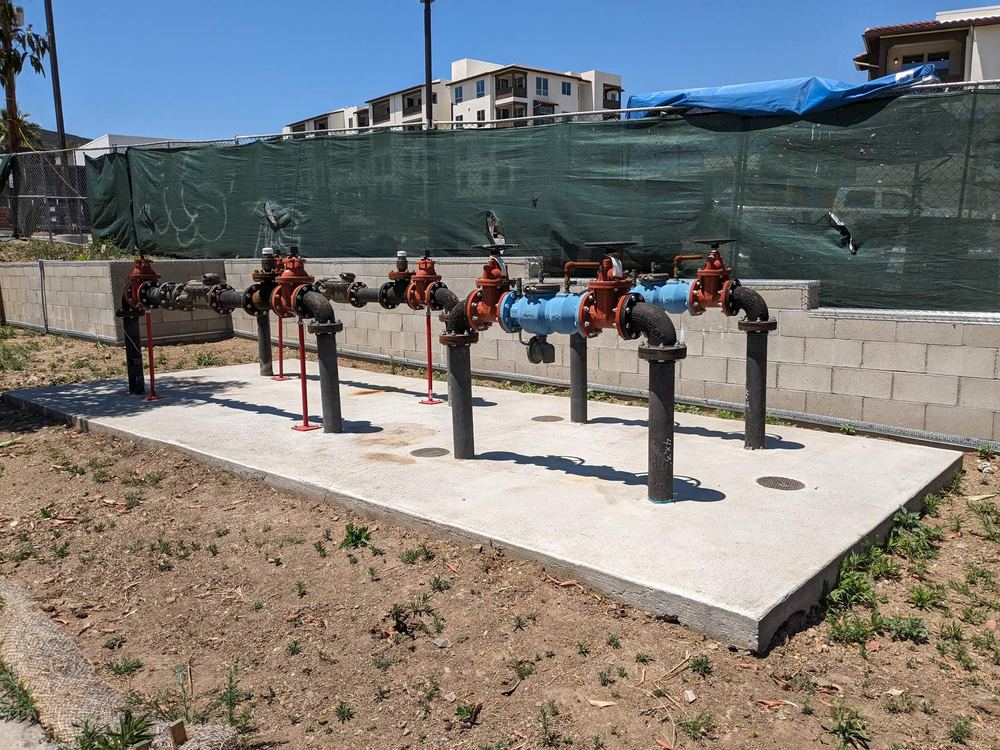
One caution worth stating plainly, because it still causes failed inspections: some older city handouts still cite the old state "Title 17" cross-connection rules. California replaced those with the CCCPH cross-connection handbook in 2024, and current Newport code is Title 14, Chapter 14.10. If a contractor hands you a test form citing Title 17, or tells you a dock hose bibb vacuum breaker satisfies the requirement, they are working from outdated rules. We test and file to the current code, and we will tell you when an existing installation does not meet it — before the city does.
Why Dock Assemblies Fail Faster Than House Assemblies
A backflow assembly on a house wall lives a sheltered life compared with one on a dock. Salt air corrodes springs, seats and test cocks. Tides and king tides — the next windows are Nov 24–26 and Dec 23–25, 2026, and Jan 21–22, 2027 — submerge low assemblies and drive silt and sand into relief valves. Boats bump pilings, dock work moves lines, and winter storms shake loose what summer heat expanded. The result is that dock RP assemblies fail tests at a noticeably higher rate than indoor assemblies, and the most common failures are the same every year: a first check valve that no longer holds tight, a relief valve that dribbles continuously, and test cocks seized shut by corrosion so the test cannot even be completed.
Salt-air corrosion
Stainless internals and brass bodies last longer than bargain assemblies, but even good ones need their test cocks exercised and their relief valves checked. An assembly that has not been touched since last year's test is the one most likely to fail this year's.
Tide and storm exposure
Assemblies installed too low, or on the water side of the bulkhead, get submerged at king tide and battered in storms. Correct placement — landward of the bulkhead, with clearance — is the cheapest flood insurance a dock line has.
Hose and washdown hazards
A dock hose left in a bucket, a bilge wash, a fish-cleaning sink or a boat washdown station creates a direct cross-connection. The RP assembly is the only thing standing between that water and the drinking supply — which is exactly why the city requires RP, the highest level of protection, on docks rather than a lesser device.
Second homes and rentals
A large share of Newport's waterfront homes sit empty part of the year, and dock assemblies on those homes fail silently — nobody is there to notice the relief valve dribbling or the dock pressure dropping. Annual testing catches it, and a photo report sent to the owner closes the loop.
How a Dock Backflow Visit Works
1. Locate and inspect
We find the assembly, check its placement against the code — downstream of the meter, landward of the bulkhead, 12 inches of clearance, USC-approved model — and inspect for corrosion, leaks, submersion damage and missing test-cock caps. If the assembly is not where the code says it should be, we tell you before testing, because a test on a non-compliant installation does not fix the compliance problem.
2. Certified test
A certified tester gauges both check valves and the relief valve against the manufacturer's specifications and the current CCCPH procedures. You get pass/fail on each component, not just a single stamp — so if the first check is marginal, you know it before it becomes a failure next year.
3. Repair or replace, quoted first
Most failures are rebuilds: check-valve kits, relief-valve kits, test-cock replacement. Where the body is corroded through or the model is no longer on the approved list, replacement is the honest answer. Either way the price is quoted in writing before work starts, and the retest is included.
4. File with the city
We file the test report with the City of Newport Beach and send you a copy the same day — the step that previous companies most often skip, and the step that actually keeps your water on. If you manage multiple docks, an HOA or a marina, we file the whole set and give you a single compliance summary your board or manager can use.
For general backflow work beyond docks — irrigation systems, fire lines, commercial assemblies and house-side devices — see our backflow testing & repair page. For tide-driven flooding and the pumps that keep low-lying waterfront homes dry, see flood & sewage ejector pumps. And if your dock line is leaking now, or water is where it should not be, our emergency plumber page is the fastest route to a crew.
Dock & Pier Backflow Pricing — Published, Flat, In Writing
Typical Newport Beach ranges. Your exact flat-rate quote is written and signed before work — assembly size, condition, access and whether the installation itself needs correcting all move the number, and we will show you exactly how.
| Dock backflow job | Typical Newport Beach range |
|---|---|
| Annual RP test, certified, report filed with the city | $95–$175 |
| RP rebuild (check-valve / relief-valve kit, retest included) | $250–$650 |
| Test-cock replacement / seized-cock service | $150–$350 |
| RP assembly replacement (like-for-like, retest + filing included) | $900–$2,200 |
| New RP installation for a pier or dock (assembly, placement to code) | $1,200–$2,800 |
| Relocation to code-compliant position (landward of bulkhead) | $600–$1,500 |
| Multi-dock / HOA / marina testing program (per assembly) | $85–$150 |
Ranges are typical-market figures for planning, confirmed against your assembly before you commit. A test that fails is never a surprise bill: the rebuild or replacement price is quoted before we touch a wrench, and the retest and city filing are included in the repair price.
Dock Backflow Across Newport Harbor — Where the Docks Are
Balboa Island · 92662
Bayfront homes around the Grand Canal and the island's outer seawall — dock RP assemblies are a way of life here, and ferry logistics mean we stock the common RP kits on the truck so a failed test is usually a same-visit rebuild.
Lido Isle · 92663
Waterfront on all sides and guard-gated, so docks are everywhere and access has to be scheduled with the gate in mind. We batch Lido testing by street where owners coordinate, which is how multi-dock pricing works.
Balboa Peninsula · 92661
Bay-side docks behind Peninsula homes, plus the commercial and rental docks near the ferry landing. Salt air and heavy guest turnover make annual testing — and a photo report for the owner — especially important.
West Newport & Bayview · 92663
Bayfront homes along the harbor's western reach, where older dock lines and older assemblies are common. Relocation to a code-compliant position is a frequent job here, as the original install predates the current bulkhead rule.
Newport Coast & Crystal Cove · 92657
IRWD territory, not City of Newport Beach water — different water district, different backflow program and filing route. We confirm which side of the line your dock is on before quoting, because a city filing for an IRWD property helps nobody.
Corona del Mar · 92625
Harbor-front homes and the village's private docks, where dock lines often run long distances from the meter. Long runs mean more joints, more exposure and more reason to test on schedule rather than waiting for a failure to announce itself.
One practical note for every dock owner: before your test date, clear access to the assembly — trim back the planter, move the stored dock box, unlock the gate. A tester who cannot reach the test cocks cannot complete the test, and a second visit costs everyone time. If your assembly is submerged at high tide or boxed in by decking, tell us when you book so we bring what the relocation conversation needs.
Dock & Pier Backflow FAQs — Newport Beach
Does my Newport Beach dock really need an RP backflow assembly?
Yes. Under Newport Beach Municipal Code Title 14, Chapter 14.10, every pier and dock requires a reduced-pressure (RP) backflow assembly — installed downstream of the meter, landward of the bulkhead, with 12 inches of clearance, from the USC Foundation's approved list. A check valve or hose-bibb vacuum breaker does not satisfy the requirement for a dock.
How often must a dock backflow assembly be tested?
Annually, and again after any installation, repair or relocation, under NBMC §14.10.025. The test must be done by a certified tester and the report filed with the city. The city mails a reminder about 30 days before your due date, and non-compliance can lead to water shutoff under §14.10.035.
How much does dock backflow testing cost in Newport Beach?
An annual certified RP test with city filing typically runs $95–$175. A rebuild of a failed assembly typically runs $250–$650 including the retest and filing, and a full replacement typically runs $900–$2,200. Your exact flat price is quoted in writing before work starts.
What happens if my dock assembly fails the test?
Most failures are rebuilds — a check-valve kit, a relief-valve kit, or seized test cocks — completed the same visit where parts allow, followed by a retest and a fresh filing with the city. If the body is corroded through or the model is no longer on the approved list, replacement is the honest answer, quoted before we start.
Why do dock assemblies fail more often than house assemblies?
Salt air corrodes springs, seats and test cocks; king tides submerge low assemblies and drive silt into relief valves; and dock work and boat traffic disturb lines. Correct placement landward of the bulkhead, with clearance, plus annual testing, is what keeps a dock assembly in service instead of failing at the worst moment.
Do you handle HOA, marina or multi-dock testing programs?
Yes. We test whole sets of dock assemblies in one program, file every report with the city, and give the board or manager a single compliance summary. Multi-dock testing typically runs $85–$150 per assembly, and we schedule around gate access on Lido Isle and ferry logistics on Balboa Island.
Your Dock Test Is Due Every Year — Whether the Letter Arrives or Not.
Book the certified test, get the repair if it fails, and get the report filed with the city — in one visit.
☎ Call (949) 693-0223